Karhu LabAX Design Studio

THINK

Turning people’s relationship with AI into organisational strength.

RELACTIS is an AX organisational development service that makes visible how each employee works with AI, and links it to team dialogue and work experiments. The individual diagnostic takes about four minutes – no sign-up, and anonymous is fine.

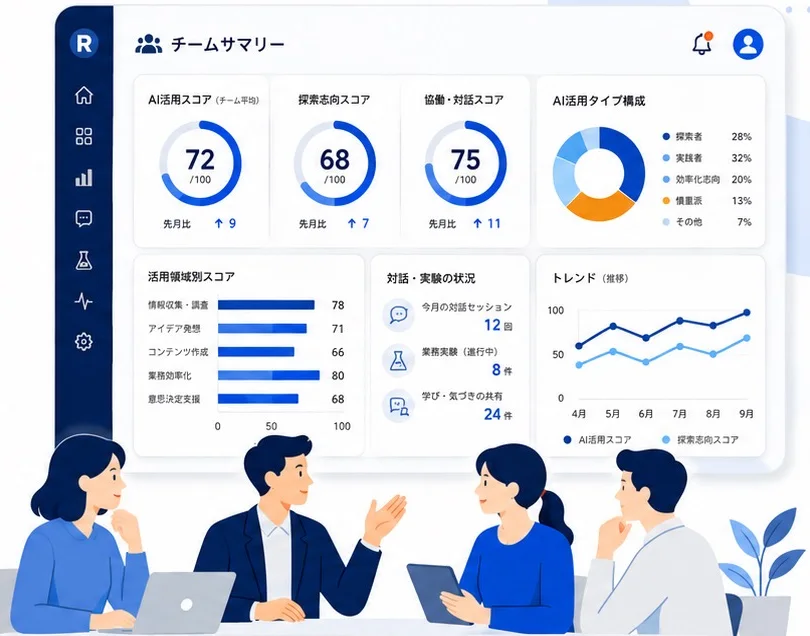
RELACTIS team summary screen: a team discusses AI-use scores and the mix of types (shown in Japanese).

PROBLEM

Why doesn’t AI use spread across the organisation?

Don’t leave AI use to individual effort or flair. RELACTIS makes three walls visible: the individual, the team and the organisation.

01 PERSONAL

The individual wall

  • AI use is concentrated in a few people
  • Training doesn’t stick in daily work
  • People don’t know which way of using it suits them

02 TEAM

The team wall

  • Big gaps in enthusiasm between departments and teams
  • Roles don’t make use of people’s differences
  • Teams don’t know how to use AI as a team

03 ORGANIZATION

The organisational wall

  • Managers or the culture hold AI use back
  • Individual know-how doesn’t become organisational knowledge
  • The next step after rollout isn’t clear

RELACTIS turns AI use from something left to individuals into a theme the organisation takes on.

PHILOSOPHY

The diagnostic is the entrance to a relationship.

Three ideas – Relate, Act and Lattice – link the diagnostic to practice and organisational change.

01 RELATE

See the relationships

Make visible how people relate to AI and to teammates, and put your differences into words.

02 ACT

Put it into practice

Don’t stop at the diagnostic: link it to work experiments and 30-, 60- and 90-day action plans.

03 LATTICE

Weave it into the organisation

Turn individual change into a shared team language, and anchor it in how the organisation works.

Types are not labels for evaluation or selection – they are hypotheses to start a conversation.

OVERVIEW

From Profile to Pulse, as one continuous experience.

From the individual diagnostic through team analysis, dialogue and practice to ongoing measurement – supported end to end.

  1. 01PROFILEIndividual diagnostic

    Makes each person’s style of working with AI, and their strengths, visible

  2. 02TEAMTeam analysis

    Shows the team’s make-up, complementary relationships and ways of working together

  3. 03STUDIODialogue workshop

    Turns challenges and possibilities into a shared language, based on the results

  4. 04ACTIONAction design and support

    Work experiments and 30-, 60- and 90-day action plans

  5. 05PULSEOngoing measurement

    Measures change continuously and feeds learning and improvement

  • SaaS: Profile / Team / Team Studio / Pulse
  • Support: AX consultants, centred on Studio and Action

Not stopping at the diagnostic – carrying it through to team dialogue and changed behaviour.

PROFILE

24 questions, a three-dimensional view of how you work with AI.

The individual diagnostic takes about four minutes – no sign-up, and anonymous is fine. From 24 questions it shows 7 factors, 15 types, and even your second and third faces.
  1. 24 questions
  2. 7 factors
  3. 15 types
  4. 2nd & 3rd faces

7 factors (AI behaviour traits)

  • Creating
  • Bridging
  • Self-driving
  • Spreading
  • Systematising
  • Verifying
  • Engaging

What each person gets

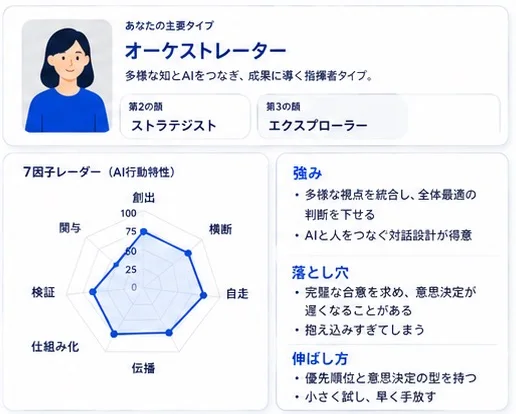
  • An explanation of their main type
  • Their second and third faces
  • A 7-factor radar
  • Strengths, pitfalls and how to grow
  • Partner types, an AI coach and a learning plan
Individual result screen: main type “Orchestrator” with second and third faces, a 7-factor radar, and strengths, pitfalls and how to grow (shown in Japanese).

Because individuals make it their own, the way in for the organisation gets lighter.

TEAM ANALYSIS

Individual differences, as a shared team language.

Not who is best, but what you see when you lay the whole team on top of each other.

What becomes visible

  • Distribution of the 15 types and a complementarity map
  • Average 7-factor radar
  • Comparison between departments
  • Role × type
  • Top types × second faces
  • Comparison with last time

What the organisation report shows

  • Balance of offence and defence
  • Talent mix index
  • Exploration level
  • Blank zones
Organisational survey
The organisation’s strengths and issues, quantitative and qualitative
AI organisation report
AI interprets and analyses, and makes insights visible
Team composition hints
Hints for role allocation and development

Each person’s difference becomes one map of the organisation.

TEAM STUDIO

Use the results to actually design teams.

Team Studio lets you weigh swapping members, or composing a team for a purpose, through simulation rather than gut feeling.
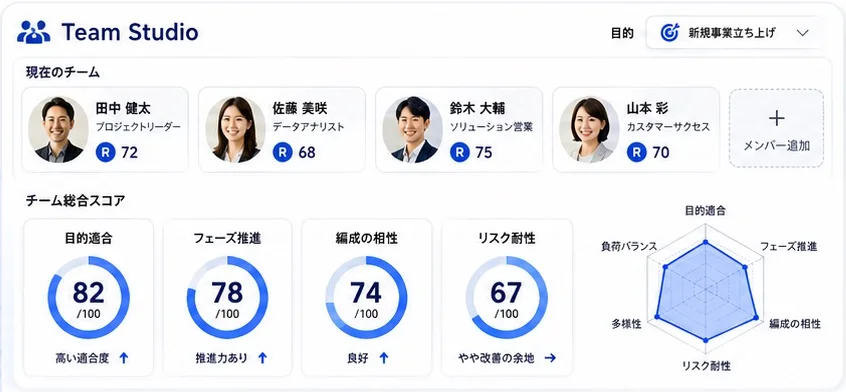
Team Studio screen: scores and a radar for a four-person team’s fit to purpose, phase drive, chemistry and risk resilience (shown in Japanese).
Four axes of the simulation
  • Fit to purpose
  • Phase drive
  • Team chemistry
  • Risk resilience
Three AI suggestions
AI proposes team compositions that fit the purpose
One-swap simulation
See instantly how the scores change if one member is swapped
Departure impact simulation
Shows how losing a particular member would affect the team
Improvement suggestions
Concrete actions that shore up weak scores
6-month score forecast
Simulates the team’s growth scenario over time
One page for the board
Conclusions and evidence, exported on one page

From a diagnostic for dialogue to a simulation for team design.

HOW TO START

Diagnose, talk, and go as far as you need.

A light way in, results that stay in the organisation. Start with the SaaS alone, or combine it with hands-on support.

  1. 01Free individual diagnostic

    Try it in a few minutes and see how you work with AI

  2. 02Team rollout

    Collect results in the target department and see the distribution and complementarity

  3. 03Dialogue and design

    Based on the results, design work experiments and 30/60/90-day actions

  4. 04Decide how to continue

    Continue with the SaaS, or move on to hands-on support

Try the free diagnostic first

Know the differences. Change the relationships. The organisation starts to move.

FORMAT & FEES

From diagnosis to embedding.

For
Companies and organisations moving AI forward – a single department is fine.
Format
The SaaS alone (Profile / Team / Team Studio / Pulse), or combined with hands-on support from AX consultants, centred on Studio and Action.
After
Reviews and structures make it stick – it leads on to Designing work and AI.
Fees
Quoted to fit the number of people and the scope. The first conversation is free.

CASECase

In practice.

CASE 01 | ManufacturingAI training, workshops and an organisational surveyRELACTIS made things visible before the AI training and workshops. People and teams have kept using it since.See the case

FAQQuestions

Common questions.

How long does the individual diagnostic take?

About four minutes, 24 questions. No sign-up is needed, and you can take it anonymously.

Are the results used for performance reviews?

Types are treated not as labels for evaluation or selection, but as hypotheses to start a conversation.

Can a single department take it?

Yes, starting from a single department is fine.

Is it useful if we barely use AI yet?

Yes. It shows not only who uses AI, but where the potential and the hesitation lie.

What do we come away with?

Each person’s tendencies, the state of the organisation, and, combined with interviews on the floor, a prioritised map of issues and the order to work in.

Is there support after the diagnostic?

Yes. Reflection and system-building take it through to something that sticks. It leads on into Designing work and AI.

What does it cost?

We quote based on the number of people and the scope. The first consultation is free.

CONTACT

Turn that unease
into a first step.

A vague sense that something’s off,
or a small hunch that AI could help,
is enough.